 We all know that starting fast can give athletes a great advantage in any race. In an open water race where a lot of people are competing is even more essential because it will help you get a better place in the racing terrain. That means that if you don't start fast you will find yourself stuck in the middle of a huge group of swimmers without the ability to slip out of this situation without getting bumped or tripped and losing a great deal of time and precious seconds of your time. A fast start is also good for triathletes too, although many of them approach the swim as a warm up for the bike and wun work they have to do later on their race. A part from the psychological boost they'll get, keep in mind that a few seconds lead in swimming translates into a lot more seconds in the bike part of the race because cycling is much faster than swimming.
Showing posts with label swimming technique. Show all posts
Showing posts with label swimming technique. Show all posts
Monday, September 30, 2013
How to start fast in an open water race
We all know that starting fast can give athletes a great advantage in any race. In an open water race where a lot of people are competing is even more essential because it will help you get a better place in the racing terrain. That means that if you don't start fast you will find yourself stuck in the middle of a huge group of swimmers without the ability to slip out of this situation without getting bumped or tripped and losing a great deal of time and precious seconds of your time. A fast start is also good for triathletes too, although many of them approach the swim as a warm up for the bike and wun work they have to do later on their race. A part from the psychological boost they'll get, keep in mind that a few seconds lead in swimming translates into a lot more seconds in the bike part of the race because cycling is much faster than swimming.
Saturday, September 28, 2013
Swimming workout: Find your balance point in breaststroke
 I know that a lot of you enjoy a nice swimming practice on Sundays. So, I have a special workout for you that will help you find your balance point in breaststroke. Before you get into the water you would like to try a dryland exercise that will hep you get the feeling of the basic rocking motion in breaststroke. The exercise is called rocking drill (obviously you can find the same drill under a different name) and you lie on an exercise mat on your chest (prone). Then you alternately rock your head and chest up as you bend your knees and raise your heels toward your buttocks, then you rock you head and chest downward as you straighten your legs. I would love to hear your comments on the workout, and let me know what would you like the focus of the next workout to be. Enjoy!!!
Thursday, September 26, 2013
Mistakes to avoid during the release and recovery in backstroke
Although the release and recovery in backstroke seems as an easy job to do, swimmers make many mistakes during these two phases of the armstroke that can lead to an increase in resistive drag or disrupt the rhythm of the stroke. These mistakes are: to bring the arm out of the water with the little finger up and the palm facing out, to bring the hand out of the water with the palm facing down, to initiate recovery by lifting the hand rather than rolling the shoulder up, and to swing the arm low and to the side.

Let's take a closer look to each one of these mistakes that can affect your swimming technique.
Wednesday, September 25, 2013
Low profile breathing swimming workout
 A lot of swimmers, especially young ones and beginners, tend to rotate to much or they rise their heads up while breathing in freestyle. Swimmers who do that mistake lose balance and they don't swim straight which leads to neck pain and loss of speed. We all know that the better the technique the better we work out. With that in mind, I'll post various swimming workouts that will help you improve your swimming technique as well as challenge you aerobically. If you have any questions about the workout or the format that I'll use to write it, please make a comment or pm me.
 Tuesday, September 3, 2013
Common mistakes during the insweep, upsweep, and release in freestyle
This is the last post on the mistakes during the armstroke in freestyle series and it will cover the insweep, the upsweep and the release. You can find the rest posts of these series here (recovery and entry) and here (downsweep).

Friday, August 30, 2013
What can go wrong during the downsweep in freestyle
Today we're going to discuss the mistakes that swimmers usually do during the downsweep in freestyle. The most common of them are to drop the elbow, to maintain the arm in an extended position, to slide the hand out to the side too much, and to slide the arm out to the side too little.

Thursday, August 29, 2013
Common mistakes during the recovery and entry in freestyle
As you already know the armstroke in freestyle is divided into seven parts: the entry and stretch, the downsweep, the catch, the insweep, the upsweep, the release and the recovery. Today we're going to discuss a few common mistakes that swimmers do during the recovery and the entry. Making these adjustments is important to improve your technique.

Tuesday, August 27, 2013
5 tips to avoid sinking legs
Dealing with sinking legs is a major challenge for beginner swimmers as it adds huge amount of drag. The extra drag from this low body position slows swimmers down dramatically and can be really frustrating because swimmers can't enjoy this activity. The prevailing theories that begginers have on sinking legs typically revolve around:
- I'm sinker.
- I'm a weak kicker.
- I'm not going fast enough.

Tuesday, May 7, 2013
Four easy steps to freestyle [video]
Today's post is about freestyle and how to learn it for the beginners or improve it for intermediate swimmers. It’s something I wanted to post for a long time now but since the swimming facility in my home town was closed for eight months it was impossible. In the following video I present 3 freestyle drills that will help you learn how to breathe properly and how to move your body during this stroke. Before you start practicing these drills you should be able to balance in the water and can put your face in the water.
Tuesday, April 30, 2013
Breathing mistakes in butterfly
The butterfly stroke has five elements: armstroke (entry and stretch, outsweep, insweep, upsweep, and recovery), kicking, body position, breathing, and when you put them altogether, timing is crucial. Swimmers tend to do mistakes in each one of these elements and through this blog I try to help them identify these mistakes and correct them. I have already blogged about the mistakes that swimmers do during the recovery (here), when they kick (here), and timing mistakes (here). Today I will go through the most common mistakes during breathing when swimming butterfly.

Thursday, April 25, 2013
Tips to improve your kicking
Kicking is a very important aspect in swimming and we all know that better kicking equal better swimming. Here are a few tips from Wayne Goldsmith that will help you improve your kicking in no time.

Tuesday, February 26, 2013
Common mistakes during the insweep of the armstroke in breaststroke
As you already know the armstroke of breaststroke is divided into four parts: the outsweep, the catch, the insweep, and the recovery. A few days ago I blogged on the common mistakes that swimmers tend to make during the outsweep of the armstroke (see here). Today’s post is about mistakes swimmers do and should avoid during the insweep.
The most common mistake that swimmers make during this phase of the stroke is to direct the hands forward. The forward speed of the body will drop off dramatically once swimmers begin to move the arms forward during the insweep. Consequently, they will either terminate the insweep early or they will waste time and effort performing a movement that is non propulsive. The forward and inward arm movement produces an outward and backward drag force and a forward and outward lift force. Swimmers are bound to decelerate when they sweep the hands forward during the insweep because any small forward component of force that may be produced by this direction of limb motion will be negated by the large backward component of the drag force they are also producing.

Tuesday, February 19, 2013
Common mistakes during the outsweep of the armstroke in breaststroke
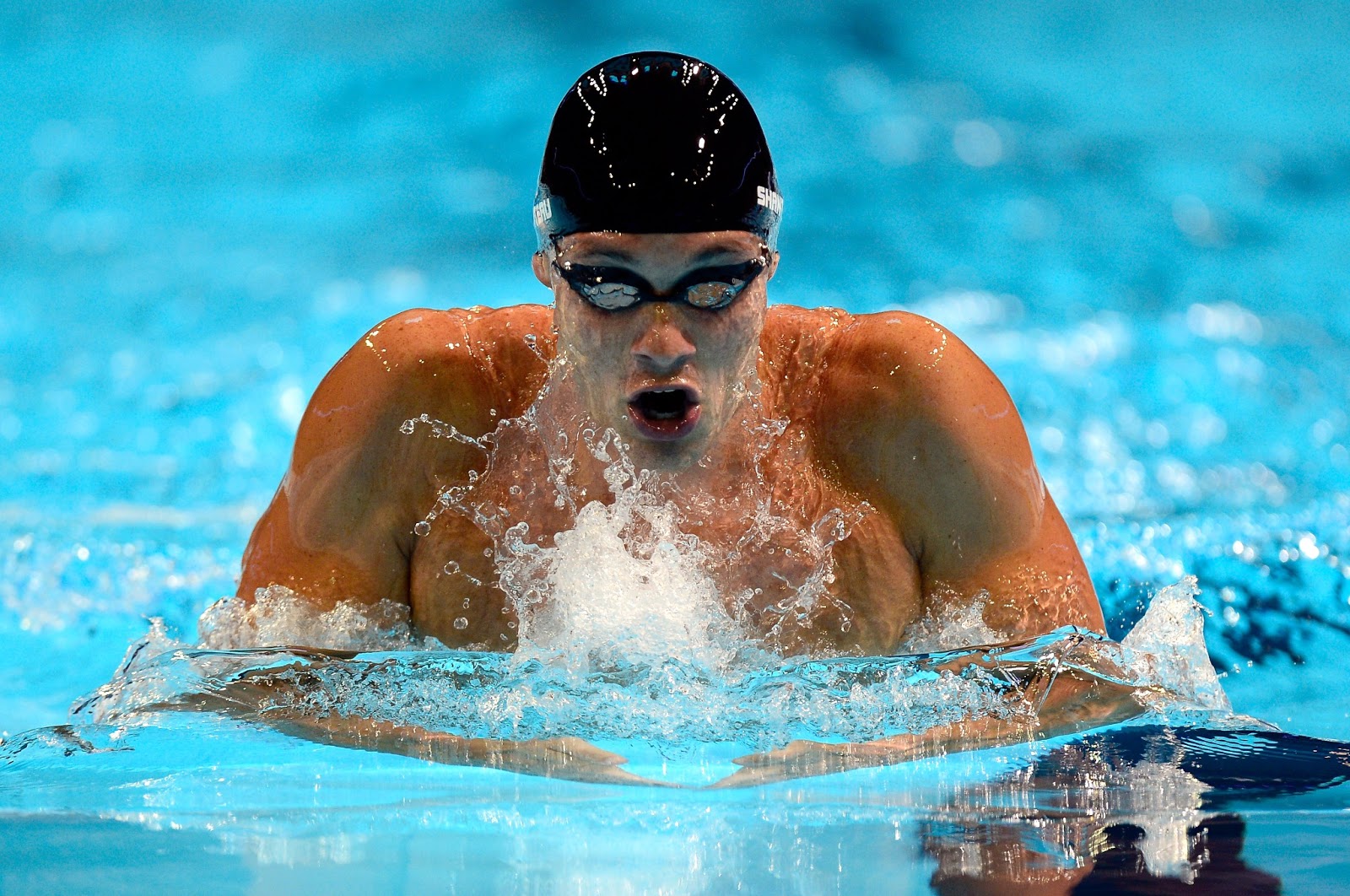
The armstroke of the breaststroke is divided into three parts, the outsweep, the insweep, and the recovery. During these parts swimmers can make mistakes that they should avoid. Today I’m going to list down the common mistakes that can be done during the outsweep of the armstroke. The mistakes that are more common during the other two parts will be described in the following days.
Tuesday, February 12, 2013
Make the best out of your backstroke start
Just as with the forward start (see here), there are several kinds of backstroke starts. Three basic types are the traditional start, the newer Japanese start, and the catapult start. In the traditional start, the hips are close to the wall and the shoulders close to the block, so the torso is practically vertical and the knees are bent to an extreme. The Japanese start is characterized by the torso angling slightly away from the wall and the head leaning back; this is the quickest of the starts. In the catapult start, the hips are away from the wall, the knees are bent only to about 90 degrees, and the shoulders lean in close to the hands, so the torso is angled into the wall. The catapult start is better for age groupers because the pressure of the feet is directed horizontally into the wall.

Subscribe to:
Posts (Atom)
-
 Hormones play important roles in providing energy to the muscles and nerves. They are also involved in replacing that energy. In addition, t...
 -
 Today's post is another great swimming workout that will help you with the breath in butterfly. Butterfly breathing should be as low as ...
 -
 Exciting news for fellow swimming fans from Turkey. The Turkish swimming federation has signed a three and a half year agreement with TSE co...